Saturday, May 18, 2013

My Visit to the National Marine Life Center!

After I attended my first International Sea Turtle Symposium in Baltimore, I took a flight up to Boston and a bus down to Cape Cod to visit my friends at the National Marine Life Center. I was a 2011 summer intern at the NMLC, assisting with brackish and freshwater turtle rehabilitation, environmental education to people of all ages, seal rescue and response,fund-raising, among a plethora of other responsibilities.

The NMLC has been building a brand new, state-of-the-art marine animal hospital for several years, after the roof of the old building collapsed. During my internship, I assisted with preparing the hospital for our patients, but at the time there was still some logistics that had to be worked out before it was ready for seals and sea turtles. I was very proud and excited to hear that the NMLC had been cleared for patients, and this fall had accepted its first 8 sea turtle patients, and later, 3 seal patients! Naturally, it was time for a visit to see all the progress the NMLC staff and volunteers made since my last visit!

My dear friend, Wendy Horsman Wyman and I at the NMLC.

The timing of this visit was less than ideal, if you recall, that very same week Boston experienced record snowfall during "Winter Storm Nemo." This means I was stranded in Baltimore for two additional nights, then spent all day waiting for a bus that was willing to drive from Boston to Buzzards Bay, MA. The long, arduous journey was well worth it to reconnect with my mentors and fellow volunteers, and get a little sea turtle time in. After having an intensive internship at the Karen Beasley Sea Turtle Hospital working with sea turtles daily for three months, it was hard on my heart to have to return to Nebraska to finish my schooling and work at a retail store because I had to quit my sea turtle habit cold turkey.

The first few days in Massachusetts were an unexpected adventure while my host and I learned to live without power. It was a strong reminder of all we have to be grateful for, and how much of a pansy I really am.

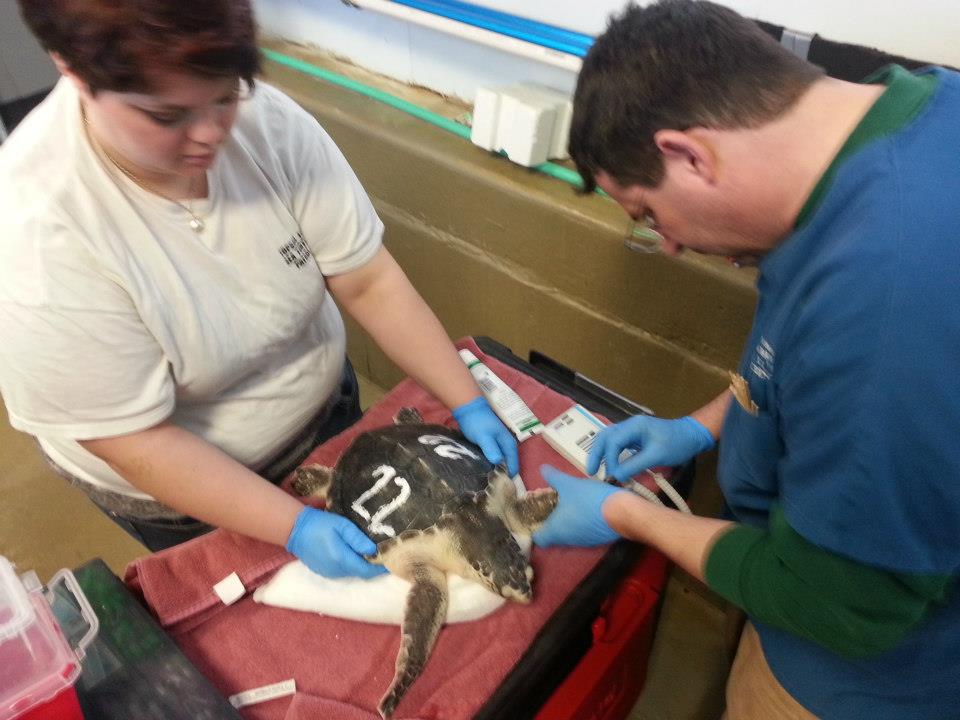
I really enjoyed seeing a totally new way of doing things at the NMLC's hospital compared my sea turtle hospital experience, they follow a similar protocol, but because the two facilities are set up so differently, they handle tank cleaning and turtle care very differently. During my week long visit, I was also able to give my first sea turtle injection; antibiotics for Papi!
Photo by Kathy Zagzebski, President and CEO of the NMLC


Photo by Kathy Zagzebski, President and CEO of the NMLC


I also enjoyed assisting and observing feeding and treatments of Townsend, the only seal patient during my visit. This was my first time working with seal patients. One particularly strong memory is our experimenting with enrichment items - we gave Townsend a barrel of snow! He's less than a year old, so it was his first time experiencing snow, and the pictures I captured from that were priceless. The video below is by my friend, Wendy Horsman Wyman.


Photo by Wendy Horsman Wyman


The 8 sea turtles are all juvenile Kemp's Ridleys, the smallest and most endangered sea turtle in the world. They were all cold-stunned, a form of hypothermia caused by getting caught in water that gets too cold for reptilian bodies. For more information on cold-stunning, and its significance to the NMLC check out my previous blog: Sea Turtles! Part 2: Disease, Predators and Conservation.


It meant so much to me to see the hospital up and running after all the work I know the wonderful staff and volunteers have put in. I'm proud to say that I was an intern with them, and that they were the rehabilitation center that started my career in marine conservation.

While I was in Massachusetts, I was excited to meet up with my fellow 2011 intern, Brittany Wolfe. It meant to much to get to catch up with her and reconnect. While we were volunteering together on my last afternoon in Massachusetts, I got the exciting news that I had been accepted to Southeastern Louisiana University with full tuition waiver and stipend. It was almost too perfect that I was able to celebrate this next step with my dear friends from the NMLC. I am lucky and honored to know such passionate people doing such meaningful work, and to say that I have been able to learn from them.

Myself restraining Carolyn, a cold-stunned Kemp's Ridley while Dr. Williams takes her heartbeat with an ultrasound machine.

Dr. Williams checks the inside of Carolyn's mouth.

Photos by Kathy Zagzebski, President and CEO of the NMLC

We can't forget the little guys! This is Pickle, an NMLC patient that  was part of the Red Bellied-Cooter headstart program at another facility.

Don't let his looks fool you, this guy is feisty!
The last thing I want to mention is that while I was in Buzzards Bay, I was graciously offered the opportunity to order an "Animal Care Team" sweatshirt along with the rest of the current volunteers, and it came to me in the mail last week. I am so proud to wear it!
To learn more about the NMLC's current patients, the recent turtle release, and all the great things they're doing for their community, please visit their website at www.nmlc.org. They are a completely nonprofit organization and rely on donations from the public to do what they do. The hospital is still under construction and needs funding! Right now, the turtles and seals share a ward, but eventually they will have separate wards, and wards for dolphins and pilot whales. Please consider being a part of their progress! You can also donate specific items that they need for their patients through their Amazon wishlist, which you can visit here.

Thanks so much to the wonderful staff and volunteers for welcoming me back and for all they've done to help me get to this point in my career. I appreciate all you've taught me, the contacts you've suggested, and the advice you've given over the years, you are my heroes!

Friday, April 12, 2013

Dear Diary: My Summer Saving Sea Turtles

There's been a lot going on in the past two months - I've accepted a full-ride offer to attend Southeastern Louisiana University in the fall studying under Dr. Roldan Valverde, a leading expert on Kemp's Ridley sea turtles and 2013 president of the International Sea Turtle Society. I'm very excited about all that awaits me there - a MS in biology, a project focused on sea turtle physiology, grant writing, teaching, and a new place to live for the next two years. 

I have a lot to write about in regard to my recent visit to the National Marine Life Center and about new goals I've set in my life - but for now I just want to share a journal entry that I wrote during my time at the Karen Beasley Sea Turtle Hospital last summer. I came across it today, and it brought me right back to Topsail Island and the sea turtle patients I worked with there. I hope that reading it helps you see the passion that I felt for the turtles I worked with, which I believe is representative of the passion that all the volunteers at the hospital feel for sea turtles. It's this passion and love that drives everything I'm doing to prepare myself for this exciting and meaningful career path.


June 2, 2012
Dear Diary, 
The turtles have stolen my heart. It's hard to write about because it's hard to do it justice. How can you explain how it feels to dream of something your whole life and then suddenly be waist deep in it? It's completely exhausting and overwhelming, it's hard to internalize that it's finally here - but when you look down and realize that you have an endangered species depending on your care - it has a big impact. 

We are being trusted with a great responsibility and I don't take it lightly. But with all the heavy stuff, I experience such great joy feeding them, scrubbing their shells clean, watching them swim. even chores like cleaning filters and washing dishes and doing laundry are fun with you do it in the name of turtles. 

I love them when they're grumpy. We are a hospital. They are our patients. Some are more tolerant than others, but we love them all. We love them for being calm and trusting, in that way that sea turtles sometimes are, we love them for being feisty and difficult, in that way that has allowed them to survive through so many world changes. We love the gentle giants, the not-so-gentle giants, we love the spunky babies. We feed and clean them, we treat their ailments, we assist the healing process and encourage them to hold on to their desire to live when they are at their weakest. But most of all, we do whatever it takes to get these animals back out into the ocean to be free and make new turtles. 

Today we swam Holiday (a baby green turtle hit by a boat) and fed her, then took her out to treat her wounds, and man, was she whipping her flippers like she had one thing on her mind - the freedom of the limitless ocean. It's so great to see her in a fighting mood - trying to bite and escape - it's how you know she's feeling better after spending the first few days entirely too still. 

I loved putting Bishop (the fiestiest of Kemp's Ridleys) on the table to hear him croak out a protest - he sounded just like a frog! He was not going to be silent about his discontent.

I like how I have to wake up Freeman (big loggerhead) by dragging the net through his tank before I can feed him because he likes sleeping in. A turtle after my own heart!

I like talking to Roanoke while letting the betadine soak into her poor, mottled shell. 

I love how RC attacks his food and always checks out what you're doing when you walk by, expecting you to produce an extra piece of squid, or watching him "work out" in his tank by swimming. I loved watching NC chase the live crab we dropped in there. 

I love restraining IC, the butterball, because she's always trying to escape. I love how Westy always attacks the broom when you're pumping the water out of her tank or how Friday loves splashing you if you stand still long enough. I love how Scuter wiggles his butt if you scratch the right place on the back of his shell. 

I also just have a lot of respect for the volunteers and staff who work here. My summer's going to be great. 

Love,
Brie

You can learn more about the turtles I mentioned in this post on www.seaturtlehospital.org where there are pictures and stories of all the sea turtle patients that come through the hospital. Please also consider making a donation if you're willing and able, for the hospital receives no government assistance and relies solely on donations from the public. 

A certain inspiring woman and sea turtle expert I know talks about "turtle karma." Like, if you love and care for sea turtles, good things will come to you. I believe I'm experiencing some turtle karma with all the good luck I've had in my search for graduate schools, and I'm hoping that I will be able to continue giving back as time goes on. Now - I'm off to continue my day, but I'll be back soon to update you on more of my adventures, and maybe I will be posting more diary entries from my summer if I find some more good ones. Take care.

Saturday, February 9, 2013

International Sea Turtle Symposium 2013 "Connections"


As a student from the Midwest, I’ve been slowly working my way into the sea turtle conservation world. There have been some major milestones along my journey, including obtaining my Bachelor’s degree, a number of valuable internships, trips and people. The newest in these major milestones is attending the International Sea Turtle Symposium on Sea Turtle Biology and Conservation (ISTS), this year held in Baltimore, Maryland. The theme of the symposium this year is “Connections,” which to me, couldn’t be more appropriate. 

            This is the first symposium I’ve attended and I feel that I learned so much from my time there. Annual symposiums like these are designed to inspire collaboration, share information, and build new ideas, while acknowledging affectionately the work of those in the past who have helped to inspire such ideas. 
An example of a presentation I attended. Presentation credit to UNC Chapel Hill, Lohmann Lab.

            The ISTS also serves as a medium to bring people together – particularly members of the International Sea Turtle Society - and create opportunities for networking. This aspect of the symposium was particularly valuable to me, and one of the most tangible ways in which I could see the theme of “Connections” at work in my career.
            First, I could see connections with things I’ve accomplished in the past few years. I saw this embodied in being able to connect again with Kate Shaffer, representing the National Marine Life Center in Buzzards Bay, MA,  my first marine animal rehabilitation oriented internship during the summer of 2011. (View my blogs from my NMLC internship here). Being able to talk to her about how things have grown and developed at the center since my visit last spring warmed my heart, and I'm excited to volunteer there next week to see these changes for myself.
            Jean Beasley was also at the symposium along with an entourage of colleagues I met last summer during my internship at the Karen Beasley Sea Turtle Hospital in Topsail Beach, NC. I was so glad to see her and discuss the leads I have on starting graduate school in the fall. (To learn more about about my summer internship experiences at the Sea Turtle Hospital, continue below to my previous entries on this page).
Sandy Sly, Brie Myre and Jean Beasley of the Karen Beasley Sea Turtle Hospital at ISTS 2013

            Re-connecting with dear friends and mentors of the past was enriching and helped to make me more comfortable. While it is certainly exciting to meet successful professionals in the field I want to work in, it also has a certain level of anxiety associated with it. I was able to make many wonderful new connections with professionals working all over the world. This conference had 1,016 attendees – and I tried to meet as many as possible. The symposium attendees represented over 80 countries, the representation of different cultures was fascinating. Walking through the hotel halls, one could hear any number of languages being spoken, people singing and dancing to drum beats.

What I appreciated most about the conference was how approachable and down to earth many of the big names at the conference were. I was floored to be able to meet and discuss ideas and projects with so many accomplished people. There was an exciting event called, “Speed Chatting with the Experts,” in which, for a donation of $5, (the money goes toward the ISTS Travel Grants which help international students to come to the symposium) you could sign up to speak to up to 6 sea turtle experts and ask them any questions that you had. I got some very kind advice and encouragement during my time in these sessions, several of whom offered me names of future contacts that may be able to help me in my journey.Though this field is so competitive, it's nice to know that it is still commonplace for us to help each other progress for the sake of the turtles.
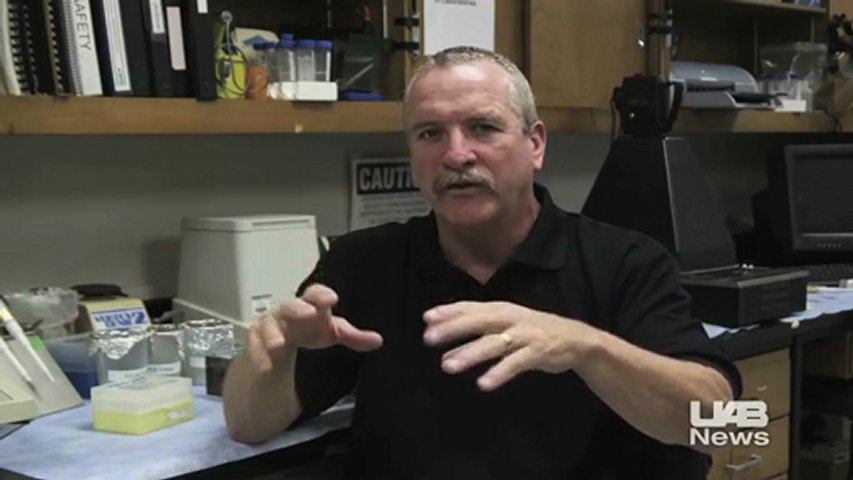
Making all these new connections was exciting because many of these people could be people I would work with in the future. Over the past 6 months, I’ve been rabidly researching graduate school opportunities including dozens of potential advisors. I was excited to meet Dr. Pam Plotkin who was so instrumental in helping me get started with my search, her encouragement and suggestions were very valuable to me in making initial contacts. After reading many prominent professor's publications, I started contacting some of these individuals who completed work that was of interest to me. It was almost surreal to then meet many of these professionals at this symposium. Another example of meeting distinguished professors who I had emailed and talked to over the phone was Dr. Thane Wibbels of the University of Alabama-Birmingham, a prominent expert in sea turtle embryo development. What’s particularly crazy about this connection is that Dr. Wibbels is an alumni of the University of Nebraska-Lincoln! Meeting a fellow alumnus of UNL who has had such success in the field I want to go into was heartening, to say the least.
Dr. Thane Wibbels. Photo credit: http://s3.vidimg.popscreen.com/original/15/eGQ2OWwwMTI=_o_researchers-fear-gulf-oil-spills-impact-on-turtle-.jpg
             While on my search for graduate school programs and advisors, I have found two promising opportunities. At this conference I was able to meet both of those potential advisors and students in their programs. My current prospects include working under the advisement of Dr. Eric Koepfler at Coastal Carolina University and working under the guidance of Dr. Roldán Valverde at Southeastern Louisiana University. I enjoyed meeting them, learning more about potential projects, and also hearing from a few of their students, all of which had glowing recommendations.
One evening I was able to have dinner with Dr. Koepfler and his group of budding young sea turtle biologists.

            Another aspect of the International Sea Turtle Society I enjoyed seeing was the “connections” between the big names in sea turtle conservation. They are like a big family – and all had amazing stories to share. These were stories of stopping poachers, diving into the ocean to catch sea turtles for study, using "cutting edge" techniques to remove hooks from turtle stomachs (excuse the pun), learning new languages and helping the public to learn to love turtles as much as we do. A talk I found particularly profound which I thought demonstrated the theme very well was the concluding session. Here, the previous president, Ray Carthy, shared a story connecting himself to Marydele Donnelly, a prominent name in conservation law, (she was also awarded the President's Award this year for all her work on the Marine Turtle Conservation Act). She then shared a story about an experience she had with another person, and so on and so forth until we came to the current president Roldán Valverde. He then told us what to look forward to in regards to the 2014 symposium in New Orleans - I can't wait for next year!

Seeing some examples of these connections in the stories I heard demonstrated something really profound to me – chance meetings, quick encounters, turtles that changed the entire course of careers and lives. Hearing stories about what incredible people are doing all over the world – making personal sacrifices, crossing difficult political and cultural boundaries, innovating technology and medicine to heal, facing bleak and sometimes gruesome situations and blazing trails. All of these things and so much more for the sake of an animal we all love to our cores.
            I spent nearly all my savings to come out to Baltimore and be a part of ISTS 2013, but it was well worth the money. I think of it as an investment in my future. I was able to meet many wonderful people doing big things for sea turtles, and gain inspiration to help push me through the next few months while I prepare for graduate school and continue my own journey. I’m excited to see how the people I met this week will play roles in my life in the coming years.

             Assuming this storm subsides at some point, I will be off to Massachusetts to see my dear friends at the National Marine Life Center to volunteer for a week and see their newly opened hospital! Stay tuned for more updates, and thanks as always for your support.

Did I mention that we had fun? The following photos come from the National Aquarium.

I had to include this one for laughs.


No blog of mine could be complete without a turtle picture or two.


Friday, July 13, 2012

Grieving and Healing

Unfortunately, life working in rehabilitation is not always the highs of victories - of nests and releases. In fact, things like this are even more precious to us because of their rarity. I made a comment in my release blog that said that the amazing experience that it was would help me to carry on through the difficult times ahead. What's funny about that comment, is that I hardly had any idea what those difficult times would really be like. June 25th, was the hardest day we’ve had at the hospital so far on an emotional level. We experienced so much defeat in a very short amount of time, and it gave the phrase “difficult times” a whole new meaning for me. However, it gave me a lot more than that as well.

On that Monday, we got 4 turtles in the course of 24 hours, all with horrific injuries, all hanging on by a thread, and two of those turtles died that day. The other two looked like they wouldn’t make it to morning. During that Monday and the days that followed I would be bashed with a lot of different emotions, all profound in their own ways. I was angry at the world for being a cruel place, and for leading these animals to such painful ends. I was disappointed with modern medicine for not being able to do more for them. In this day and age, in times of such great technology and medicinal advances, there are still times when we are useless to bring these turtles back. I was frustrated to see a beautiful animal, and know that it's giving up, and can’t stand another day of suffering. But maybe most potent for me was dealing with the injustice of the situation, I could practically taste the injustice as I thought about how this turtle should be way out there catching a ride on a current, harassing some crabs, taking a nap in the sand - or just anything else. These turtles shouldn’t be dying before my eyes. They certainly didn’t deserve this struggle. 

One of the lessons I learned that day is that sometimes our role as a hospital is not necessarily one of rehabilitation as much as it's a sanctuary. A few times last week turtles came, and we did all we could to make them comfortable. We gave them a clean space, we gave them pain medication to ease their suffering, and we kept them warm and calm, and they died in peace as a result of their illnesses or injuries. As much as it pains all of us to watch that turtle go, to monitor it and to soothe it, knowing it has limited time left with us, you have to acknowledge that the turtle is better off here than the alternative – at least while they’re here we can keep them calm, safe, and free of as much pain as medically possible. 

What I was experiencing was nothing short of a grieving process. To not only see these animals die, but to also see them suffer haunts you for a while. 

But if a job like this is often entrenched in defeat, why do we do it?

In short, we do it for the chance at victory, because we might be able to change the course of another turtle’s future. We do it for the little victories that can eventually lead to a big victory. When I think of little victories, I think of turtles that beat the odds, but do it one baby step at a time. It starts with staying alive another day, it continues with eating heartily, developing an attitude again which indicates a new found will to fight and live, the new scale growing underneath the scab, each day brings with it something new to appreciate. That’s not to say that there aren’t setbacks – hunger strikes, discouraging test results, new ailments that pop up, etc. But hope is ever present that the setbacks will be brief and progress will resume. 

I’ve experienced many of my own little victories, and seeing these sea turtles progress has been everything I’ve ever dreamed of, but one that sticks in my mind revolves around one of the turtles we got on that fateful Monday. Her name is now Nichols, and she came to us with not just one appalling wound, but two. We think that one flipper got caught in a crab pot line, completely twisting it around, mangling the flesh and becoming severely infected. This would’ve been enough to worry about – but she also had a huge hole in her back from being hit by a boat. When she came to us she was in such sorry shape that we didn’t expect her to make it through the night, and that just added to the gloom of the day. However, we were encouraged to find her alive the next morning, and the morning after that. During her first few days we primarily focused on managing her discomfort – keeping her warm and dry (we weren’t sure if she’d be strong enough to swim after all she’d been through), but we were eventually able to put her in water. The first time we put her in water has to be in the top 10 best moments I’ve ever experienced at the hospital – because she went from being so depressed and lifeless and miserable to the happiest little turtle in the world. 

As the water filled the tank, she laid there, looking listless, until suddenly she realized that she had about 4 inches of water, and she perked up and began marching around the tank, exploring it as though she’d awoken from a deep sleep. It was like a salve on my broken heart to see her so happy by the simplest of things. She was splashing and swimming, and she suddenly looked ready to fight again. She does this adorable thing where she opens her mouth while she swims around – I’m not sure if she’s just drinking, or if she’s threatening the world not to mess with her, but I like to think it’s a little bit of both. 

Nichols, swimming in her tank, ready to take on the world.
Working with this turtle has been one of the most rewarding experiences of my life. She has a long road ahead of her – she’s by no means in the clear. Her future includes surgery and extensive recovery time, but as long as she hangs in there, I will be beside the tank cheering her on. 

We love what we do because as much as the situations we are faced with may disappoint us, may break us down for a while, we know that there are turtles at the hospital waiting to surprise us, to amuse us, to enchant us, if only we give them the chance. We can’t spend too much time grieving for the ones that are lost because we can’t heal the turtles that can still benefit from our care if we are too wounded ourselves. We say our goodbyes and allow ourselves a moment and we never forget them as we move forward. We continue to clean tanks and administer treatments, but we also go out to the beaches and open our doors to hundreds of people each day to share with them the message that we all have to enact a change together.  

I am grateful for all the ways I’ve already grown through this internship, and all the new strengths I’ve started to cultivate. When I feel broken down, when I feel like the grief is too much, I just remember that if no one was willing to work through their grief, the 350+ turtles that have been released from this hospital and the turtles that have been released from other turtle hospitals around the world, would never have gotten their second chance. So we pick ourselves up and we find the strength to keep going, because Nichols needs us, because Monroe needs us, because Lefty needs us, because Ocracoke needs us, we are their caretakers, and it is our privilege to be.

Tuesday, July 3, 2012

Nesting Action in Topsail

Did you know that the Karen Beasley Sea Turtle Hospital got its start in nest protection? It's true! Many years before the Beasley family started rehabilitating turtles, they were out on the beach protecting nests from predators and poachers. This summer, the interns have been keeping the tradition alive by being active in the nesting portion of the Topsail Sea Turtle Project.

Nesting season seems to have come into full swing in the past couple weeks. So far, I've seen two nesting females, three nests, and got to assist relocating two nests. The most recent time that the interns got out to see a nesting female was the most profound to me, and I think that's because of what we all went through that day long before the loggerhead came out on the beach.

Monday, June 25th, was hands-down the most emotionally difficult day we've had at the hospital this summer. We had four new turtles come in in less than twenty-four hours, all with horrendous injuries. Two of them did not make it despite our best efforts and prayers. I was beside myself with grief when I left the hospital at the end of the day. I don't want to delve too far into this topic right now, because I plan to dedicate a future blog to it. I think it's important to mention this, though, because it's hard to understand how this experience affected me without that background.

Anyway, that night, I'd finally decided that it was time to settle in and get some sleep when we got the call at about 9:30. We hear, "TURTLE ON THE BEACH!" and there's a minute or two of complete pandemonium as people rush about the house changing clothes, putting on shoes, and running out the door to pile into the car.

Once we finally arrived on the beach and all sat in the sand to watch the female as she covered her eggs, I felt a huge sense of peace that I had been longing for all day. Here we had a healthy turtle out on the beach laying her eggs, doing exactly as she's supposed to do. She gives her babies the gift of life, and leaves them to fend for themselves, never to see them again - as it has happened for thousands of years. This is why we go through the hard times - in hopes that more turtles are out there to breed and keep the species going.

One of my favorite memories of the summer so far is when our beach coordinator gave us permission to approach the female from behind and give her a pat on the back and tell her "good job" as she headed out to the ocean. Just like, having your hand on a wild animal, and then watching her jump into a wave and continue on, forgetting you almost as soon as that water carries her out of your grasp - it makes you feel so small.

 Unfortunately, she laid her nest right in front of a huge condominium, which meant that if the babies hatched there, they could easily go the wrong way, attracted by the lights instead of heading out to the ocean. This meant that we had to relocate the nest to a more peaceful place.

The two times I've helped relocate nests have followed a pretty standard order. The first part is trickier than you might think - find the egg chamber. Turtles work hard to camouflage that chamber as best they can, so it can take quite some digging to find the nest. Here's some photos from my second relocation - the first happened at night, so there are no pictures from that experience.
When moving eggs, it's always very important to try to keep their orientation intact, because if you rotate them you can harm the egg's chances of developing properly.

At this point, we'd uncovered the eggs, and started to transfer them into the bucket to move them.

Once all the eggs are out, the beach coordinators have us take a bunch of sand from the bottom of the nest. When the female is done digging the hole for the eggs, but before she starts actually dropping the eggs into the nest, she excretes a lot of mucus, which is absorbed the the sand in the bottom of the nest. We take the sand at the bottom of the original nest and place it at the bottom of the new nest, to me, this has both scientific and sentimental properties. It's possible that the mucus contains elements that are biologically important to the development of the eggs. However, I think of it this way - this egg chamber, these excretions are all this mother can ever give to her babies. Intervening in sea turtle nests is not taken lightly by the coordinators, but it is done when they feel that we can give the babies a better chance for survival by moving them to a more suitable location. Moving the mucus-saturated sand is a small way in which we can take mama's gift and sacrifice with the eggs to the new nest.

You might be wondering how we come across nests when we aren't actually there to watch the female lay her eggs. Well, the morning of my second relocation, I got a few opportunities to see turtle tracks by checking out some false crawls.

Not all false crawl turtle tracks make the typical "U" shape. This mama wandered all over trying to find a suitable place for her nest.


 I guess what I've most learned from watching the females nest is that life goes on. It seems cheesy - but it was a salve on my heart to think that though we lost 2 turtles that day, relocating the nest that was in an improper location may have given 130+ turtle hatchlings a chance to live. It doesn't negate the loss or omit it, but it reminds us that that loss is not the end, and it's not simply a failure, it is only one part of what we do, and we still have opportunities all around us to make a difference for the future of these animals. What we did that day, and what we do each time we experience such a tragedy, as our director Jean tells us, is grieve for those that can't continue on in their struggle, but pick ourselves up and care for those that can.

Back home, my friends and I had this tradition of making a wish at 11:11. That night, after seeing off the nesting female as she took off back out into the black ocean, I looked down at my phone and it was 11:11, but I'd already gotten my wish.